Comparative & computational folkloristics
The Folklore Database
A resource for the study of folklore: search myths, legends, folktales, and religous texts, see where they are told, who tells them, and if there are other similar or related stories.
What can the Folklore Database be used for?
The Folklore Database brings together thousands of myths, legends and folktales from traditions around the world, each linked to its source, its tradition and its place on the map. It is built for comparison: finding where a story is told, how its versions differ, and whether those differences follow geography.
Search and read
- Narrative Search finds narratives by keyword through matching or semantically simiar text. Results can include geographical distribution of stories and their classificiation. These results can then be further examined in more detail.
- Metadata Search searches the references around the narratives: including bibliography and classification types, good for finding story types.
- Narrative Research and My Research lets you refine searches by tradition or classification, and keep your own collections of narratives saving time having to repeat searches.
Map and compare
- The Map of Mythologies & Traditions shows where each tradition within the database lies and what has been recorded from it.
- Compare Motifs sets the distribution of two Berezkin motifs side by side, or one motif against every tradition.
Classification systems
- Browse the Aarne-Thompson-Uther (ATU) Index, Stith Thompson's Motif-Index, the Berezkin-Duvakin Motif Catalogue, Katharine Briggs's legend classifications, Christiansen's Migratory Legends and regional indexes, each linked to the narratives they describe.
- The Character & Creature Catalogue gathers the deities, spirits and creatures that appear in the narratives.
Mythemes and analysis
- The Fielder-White Mytheme Catalogue breaks the narratives of each motif into mythemes, the recurring events and elements of a story, and records which narratives contain each one and in what order. Probably the most powerful unit in comparative folklore.
- The Comparative Mythology Workbench compares those mythemes across narratives and traditions: which elements a motif's versions share, which vary, and how the order of events differs.
- Phylogenetic Analysis tests whether a motif's pattern of mythemes follows geography, as a first filter for motifs whose versions may have spread from a common origin.
Reference
- Guides to analytical frameworks such as Propp's functions, Campbell's hero's journey and Lévi-Strauss's structural analysis, alongside the Bibliography, Statistics and Glossary of Terms.
- Character & Creature Catalogue is a dictionary of deities and creatures found in folklore./a>.
Searches by meaning, not only keywords. Every search plots its own distribution map from the matching traditions. A free account is required — register or log in.
Searches the apparatus around the narratives, not the texts. Bibliography, the ATU index, motif catalogues and Thompson's Motif-Index. A free account is required — register or log in.
Unique narratives count distinct narrative texts. Occurrence records link those texts to motifs, traditions and sources; one text can have several records. Mythemes count the distinct labels in the current Fielder-White Mytheme Catalogue; identical labels across motifs are grouped together, with definitions specific to each motif.
Every search draws its own map
DistributionSearch results aren't just a list. Each query returns the geography of a story — where a narrative or motif has been recorded — so you can see dispersal at a glance and compare traditions.
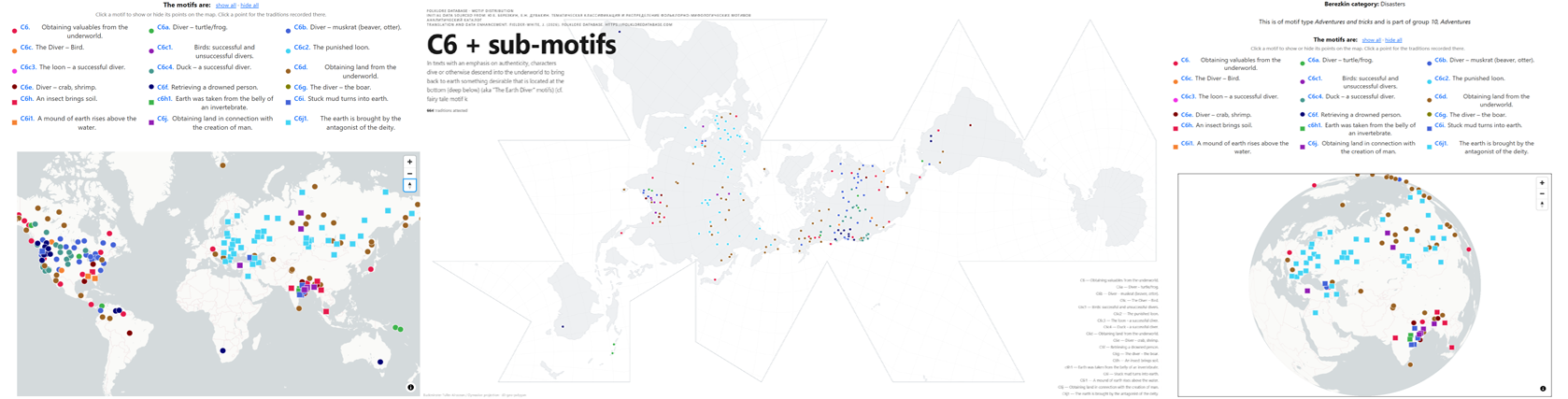
Illustrative. A real search generates the map live from the traditions that match your query.
Prefer to browse? Open the ATU tale-type index· Berezkin and Duvakin's motif catalogue· Fielder-White Mytheme Catalogue· World map of traditions.
If you wish to get access to data for projects and research, then please contact us, we do our best to help
How to cite: Fielder-White, Jonathan (2026). The Folklore Database. Citation version 1.261118.1 (18 November 2026). https://folkloredatabase.com.
 0009-0006-1672-4451
The citation version records the access date and does not identify an archived database snapshot.
Please cite the relevant sources, catalogues, and classification systems, including the Folklore Database, Berezkin-Duvakin Catalogue, ATU, Thompson, alongside the page accessed and the last time accessed. Please respect copyright and licences.
Editorial annotations and database enhancements © Jonathan Fielder-White licensed under CC BY 4.0. Berezkin-Duvakin derived narrative and metadata licensed under CC BY-NC-SA 4.0. Full rights information can be found here.
Rights in original software, interface design and other protected material not expressly licensed for reuse are reserved to their respective rights holders.
Text and data mining: For protected material not offered under a Creative Commons or other reuse licence, the Folklore Database reserves the rights it holds in automated extraction, dataset creation and AI training, to the extent permitted by law. This reservation does not restrict uses permitted by the applicable Creative Commons or other licence, public-domain status, or statutory exceptions and limitations. Third-party material retains its own terms. Please contact us for help identifying the applicable sources, licences and attribution for bulk research access.
Designed and Developed by Jonathan Fielder-White.
© 2024–2026 Crecganford / Jonathan Fielder-White. Rights reserved except where licensed or otherwise stated.